


What Are Chords In Music And What Types Of Chords Are There?

Chords, and the wide range of types of chords, are the centre of most music throughout history, from the earliest classic pieces to the most up to date modern pop tunes. But what are chords? Basically, a chord is when two or more notes are played at the same time. The reality can be a little bit more complex as there are many different types of chords to choose from, so in this chords guide, we are going to have a close look at a number of chord types and how to use them in your tracks.
In this article
- What is a chord?
- Chord Qualities
- How to write chords?
- How to build chords
- The 4 main types of chords
- Other types of chords
- What is a chord progression?
- Conclusion
What is a chord?
So what is a chord in music? Put simply, a chord is when two individual pitches or notes are played at the same time. Many instruments allow you to do this, from pianos and guitars, to any soft synth you have in your DAW. Basically anytime you hear someone strum a guitar or press two or more keys on a piano, they are playing a chord. It’s this combination of notes that creates what is known as harmony, which is what a majority of popular music is based on. So let’s have a look at different types of musical chords, and how to use them.
Chord Qualities
You can look at the individual musical notes as ingredients, then combining those different ingredients, can result in wildly different outcomes. They can create sounds ranging from bright and happy through to dark and moody, and every point in between, so choosing the right ingredients for your chord, will shape the overall feel of your track. Let’s have a look at the main qualities of a chord.
Tone
Musical tone can be described as the “quality” of different sounds or instruments. For example a piano will have a different tone than a distorted electric guitar. On the other hand we can use the word “tone” when describing the pitch of an instrument, i.e. what note is currently being played, and its relationship to other notes being played. Which leads us to…
Intervals
The space between notes of any chord can be described as an interval. If you look at a piano, each step from one note to the next black or white note is called a semitone, where a step of two notes is called a tone. This system can be used to work out the intervals between two notes. The space between any note and another note, can be measured in semitones and produce its own specific interval. We’ll return to this later, when we look at how to build a chord.
Dissonance
When talking about the different types of chords in music, dissonance is used to describe a chord that makes a harsh or unpleasant sound, this primarily comes from using an interval called a Minor Second, which means there are two notes that are only one semitone apart, being played together. This can be used effectively to make a scary horror soundtrack, but would rarely be found in any kind of commercial popular music.
Resolution
There are all types of musical chords that you can use, and when you put together a sequence of chords in a tune, you will come across a term resolution. This is used to describe the point where a sequence of chords, over time, returns to what is known as the tonic chord. This is the chord that is built from the first note of whatever musical key you are in e.g. the first note of the C Major scale is the C, so the tonic chord is a C Major chord. If your song is in the key of C Major, it would probably start with the C Major chord, go on a little journey around some other chords, then return to the root chord. When it does, this is called a resolution.
Context
There are all kinds of chords in music theory, but every type of chord will sound different if it’s played on its own, compared to what it will sound like when different chords are played before or after it, in a sequence or progression. This is called context. Here are a few examples of how a chord’s context can change its sound.
- Key signature: A chord in one key could sound nice and bright, but in another key sound more subdued.
- Preceding and following chords: The chords that come before or after the chord, in a progression, can drastically alter how the chord is perceived.
- Instrumentation: A chord played on a piano, can sound radically different to a chord on an electric guitar or synth patch.
- Song Tempo: How fast or slow your tune is can have an impact on how a chord is heard.
- Melody: the melody in a track, such as the lead vocal, can have an impact on the chord playing alongside it.
How to write chords?
The first place to start when thinking about how chords are made, is the musical key you are in. Each note of your key is the first note of a chord in that key. For example in the key of C Major you have C-D-E-F-G-A-B, all the white notes on a piano. You can use these notes as the basis of a number of different types of chords.
Each key has its own set of chords and here is the simple way of working out what chords work with each key.
Starting with the root note, the chords for a major scale are..
Major - Minor - Minor - Major - Major - Minor - Diminished
So if our key is C Major, our chords are
C Major, D Minor, E Minor, F Major, G Major, A Minor and B Diminished.

All the triad chords built of this scale, only use the notes in the scale.
Our chords for the Minor scale are…
Minor - Diminished - Major - Minor - MInor - Major - Major
So if our key is C Minor our chords are
C Minor - D Diminished - E♭Major - F Minor - G Minor - A♭Major and B♭ Major

Just apply this system to any scale to find out which chords you can use in your track, based on its key.
How to build chords
We can use the notes from any key to build our chords, by simply adding additional notes from the key to play at the same time as the root note from the chord. Here is where intervals come into play. Each interval has a different name and increases by one semitone per interval.
Semitones Interval Name
1 Minor Second 2 Major Second 3 Minor Third 4 Major Third 5 Minor Fourth 6 Major Fourth 7 Perfect Fifth 8 Minor Sixth 9 Major Sixth 10 Minor Seventh 11 Major Seventh 12 Perfect Octave
The 4 main types of chords
You can use the intervals to build any kind of chord you like. There are different types of chords in music that you should be aware of, here are the four main types of chords.
Major chords
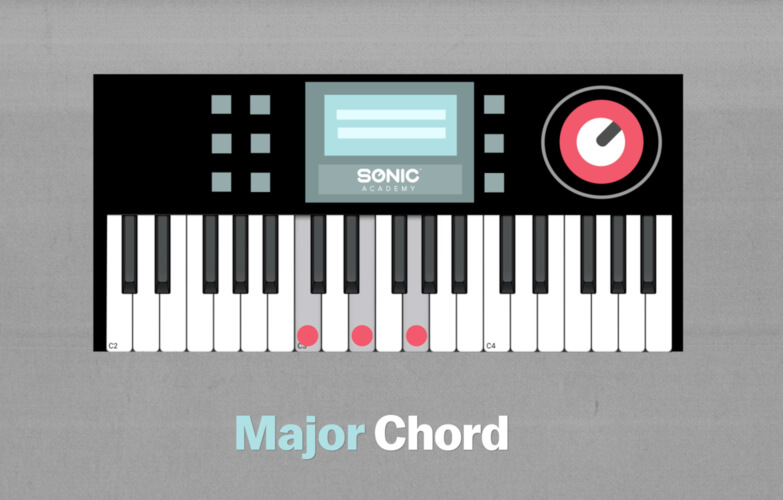
What does a major chord mean? A major chord can usually be described as being happy or uplifting. It has three notes starting with the root note, a major third and a perfect fifth, so for example, a C Major Chord would consist of the notes C, E and G.
Minor chords
What does a minor chord mean? A minor chord is usually perceived as more sad or dark in tone. It comprises the root note, and minor third and perfect fifth, so only one semitone different than a major chord. For example the C Minor chord would have the notes C, E flat and G.

Diminished chords
What does a diminished chord mean? A diminished chord is formed from a root note, a minor third, and a diminished fifth (a semitone lower than the perfect fifth). It tends to be used when the composer wants a feeling of tension of unease in their chord progression.

Augmented chords
What does an augmented chord mean? An augmented chord consists of a root note, a major third, and an augmented fifth (a semitone above the perfect fifth). These types of chords can feel a little dreamy or mysterious, and can be found in movie scores a lot.

Other types of chords
While most popular music is written using the major and minor chords, there are a wide range of other types of chords in music that can be used when composing. To talk about all chord types would take forever, but here’s a few different chord types that could be useful.
Seventh chords
These four note chords add a seventh interval to the basic three note (triad) chord. They add a richness and complexity to a chord. If you are currently only using basic three note chords in your track, why not try adding a seventh interval note to those chords, to see what difference it makes. Adding a seventh note can really affect the quality of a chord. For example if you have the C Major chord of C-E-G you can add the B note on top to create your seventh chord.

Dominant seventh chords
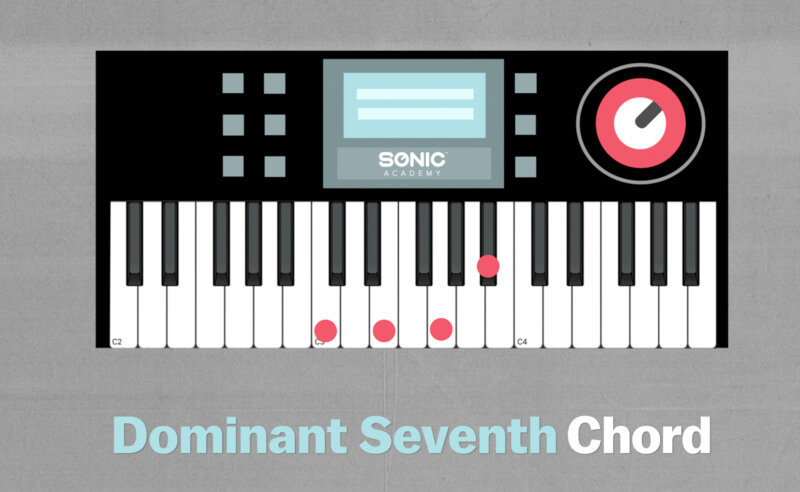
Similar to the seventh chord, but this type of chord specifically adds the minor seventh interval, so the chord has a root, major third, perfect fifth, and minor seventh. This type of chord has lots of tension, which means it can usually be followed by the root chord as a resolution in your track.
Suspended chords
A suspended chord temporarily replaces the third of a triad with either a second or fourth. So if we look at the C Major chord, which is C-E-G, then the suspended version of that chord would be either C-D-G or C-F-G. If it replaces the third with the second note it’s known as a Sus2 chord, if it replaces the third with the fourth note of the scale, it’s known as a Sus4 chord. These also add tension and work well as chords that resolve to their original triad state in a progression.


Extended chords
These are chords that take the seventh chord and go beyond that, adding additional notes from the scale. These are then named after the numerical number for the scale that it uses e.g. ninths, elevenths etc. You can work out what note to add by moving up the scale by the required number of notes. For example a C Major Ninth chord would have the three notes from the seventh chord, C-E-G-B plus the D, which is three semitones above the B note.

Altered chords
Here’s where things can get a little tricky! Let’s talk scales first, the basic major key scale is called a diatonic scale, and features 7 notes from the 12 musical notes available. A chromatic scale is all 2 of the available musical notes, all in a row. Still with me? Ok, cool. An altered chord is one that takes a note from that record and replaces it with a note from the chromatic chord, either one semitone above or below the original note. Here’s an example.
The C Major scale looks like this;
C-D-E-F-G-A-B
So the C Major chord would be C-E-G as it uses the major third and the perfect fifth. An altered version of that chord might be C-Eflat-G or C-F-G.

To find out more about how to build different types of chords, check out some of our amazing music theory tutorials on our site.
What is a chord progression?
A chord progression is a series of chords played in a sequence, forming the harmonic foundation of a song or piece of music. Think of it as the musical journey that underpins a melody, guiding the mood and feel of the track. Each progression will use some of the chords available in the key, but doesn’t have to use all of them. Many pop songs are usually based around three or four chords, so there are no set rules when it comes to how many chords you use.
There are popular chord progressions that work in lots of different genres of pop music. Here are a few examples used in electronic music;
-
First - Third - Sixth - Fourth: This progression has an uplifting and anthemic feel, and can be heard in many big room electronic dance tracks.
-
First - Sixth - Second - Fifth: This progression creates a mix of euphoria and tension, ideal for trance and house genres.
-
First - Fourth - Seventh - Third: A more mysterious sounding progression, commonly used in ambient and downtempo tracks.
-
Second - Sixth - Fourth - First: Placing the root chord at the end of the progression is popular in many genres of dance music like progressive house.
On the Sonic Academy website we have over 3000 hours of tutorials that cover lots of different types of chord progressions that we’ve just discussed plus many more. So, if you’re still confused as to what are chords in music and how they are essential to your productions, then click here to check out what we’ve got to offer
Conclusion
What are chords is one of the most commonly asked questions for beginner stage music producers. Chords are the foundations of all popular music for centuries, and anyone making music in any genre, would do well to get to grips with how they work and how they can be used to guide the emotional response desired from any track.
On our site we have a wide range of different music theory videos that take a closer look at how chords work, with examples from some of the biggest tunes from the history of dance music. Check them out here.


